
Slim Wallet vs Smart Wallet: What’s the Difference and Which One Is Better for Everyday Carry?
Key Takeaways
- A slim wallet is defined by its compact shape and reduced bulk for essentials, while a smart wallet adds functions like tracking or quick card access.
- Slim wallets prioritize thinner shape, lighter feel, and simple front-pocket carry for minimalists using few cards or cash.
- Smart wallets prioritize better card access, anti-loss/tracking support, RFID blocking, and intentional organization for daily life.
- Many smart wallets are slim, but slimness alone doesn't make a wallet 'smart'; it's about added functionality beyond form.
- Choose a slim wallet for comfort, reduced bulk, and a simple, low-maintenance carry without needing extra features.
- Choose a smart wallet for faster card access, anti-loss support, enhanced organization, or if you frequently misplace your wallet.
If you are comparing a slim wallet vs smart wallet, you are not alone. These two categories are often mentioned in the same conversations because both are associated with modern everyday carry, minimal bulk, and a cleaner alternative to thick traditional wallets.
But they are not exactly the same thing.
A slim wallet is mainly defined by its shape and carry style. It is built to reduce bulk, fit more comfortably in a pocket, and help you carry only the essentials. A smart wallet, on the other hand, is a broader category. It may also be slim, but it can include extra functionality such as quick card access, tracking support, app integration, anti-loss tools, or RFID blocking.
So the real question is not just which one is better. It is this:
Do you simply want a thinner wallet, or do you want a more capable wallet system for everyday carry?
For anyone exploring modern smart wallets, that distinction matters. A slim wallet solves one problem very well. A smart wallet often tries to solve several.
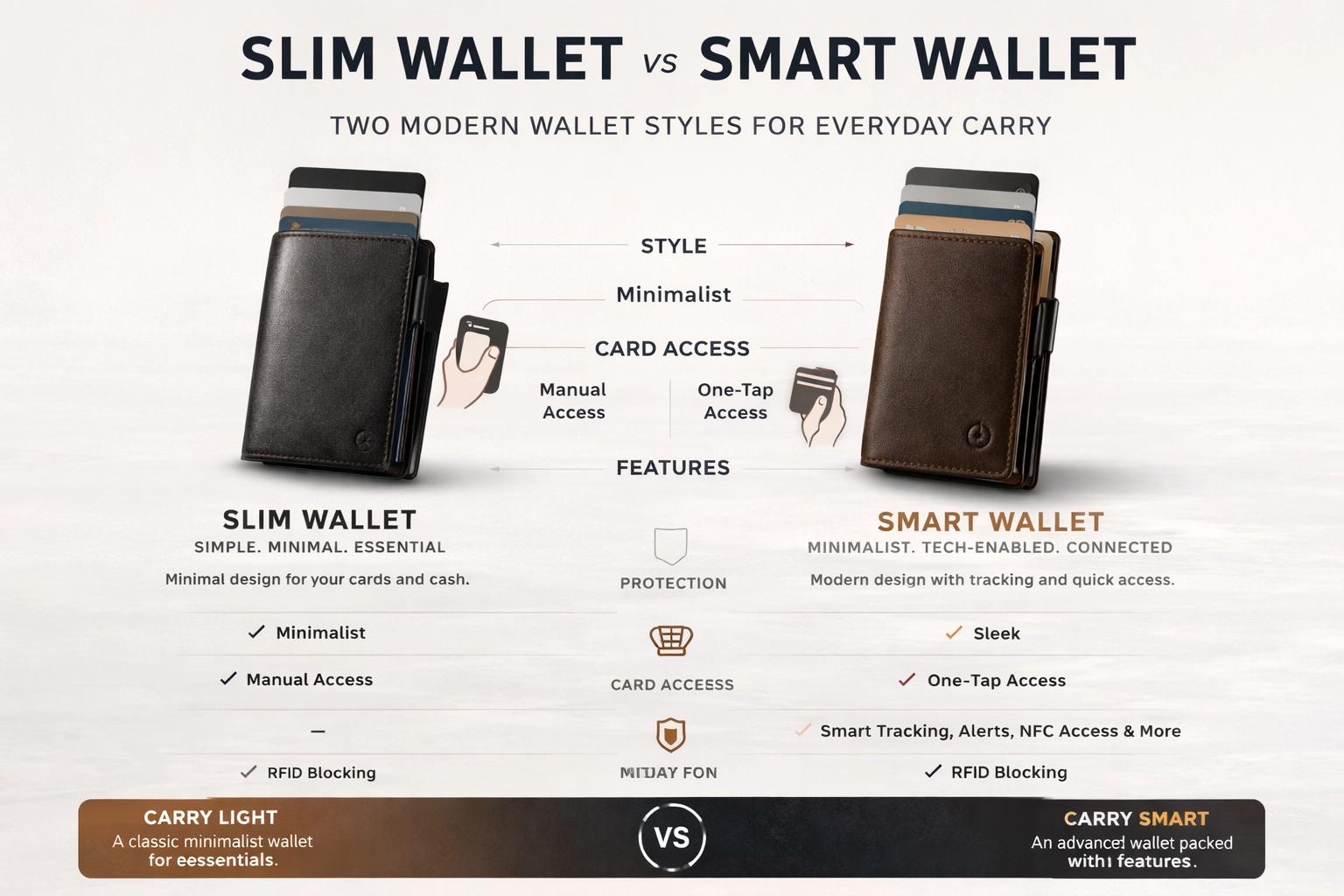
What Is a Slim Wallet?
A slim wallet is designed to reduce pocket bulk and help you carry fewer items in a cleaner, more intentional way. It usually has a compact profile, fewer compartments, and a layout that encourages card-only or essentials-only carry.
The goal is simple:
carry less, carry flatter, and carry more comfortably.
Slim wallets are popular with people who:
▪️want to avoid bulky back-pocket wallets
▪️prefer front-pocket carry
▪️only use a few cards and some cash
▪️like a more minimalist everyday carry setup
Some slim wallets are made from leather for a classic look. Others use metal, carbon fiber, elastic bands, or hybrid materials for a more modern style. But regardless of material, the defining feature is still the same: reduced thickness and simpler carry.
That means a slim wallet is primarily a design choice.
What Is a Smart Wallet?
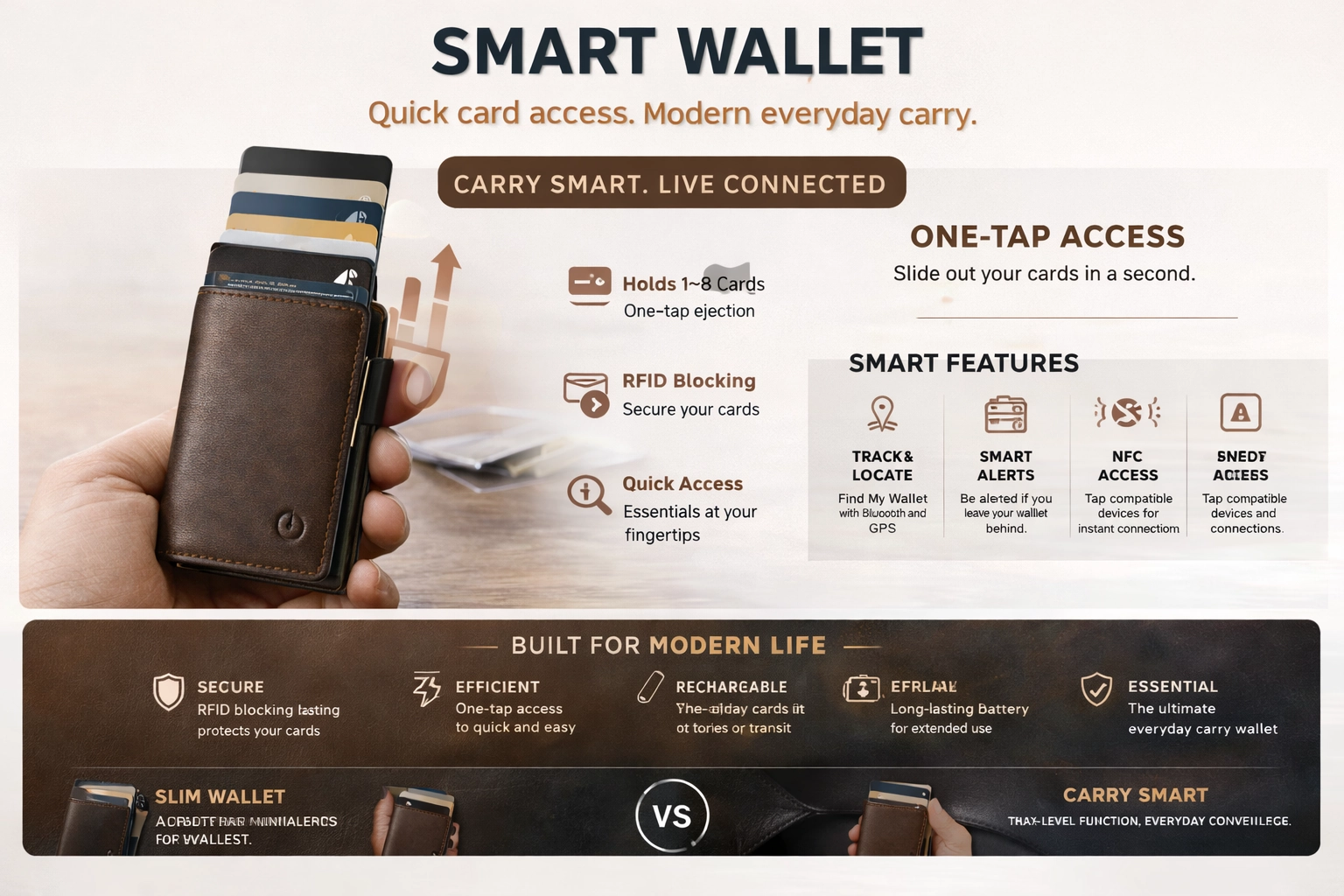
A smart wallet is a broader category built around function as much as form. It can still be slim, but it may add features that go beyond shape and storage.
Depending on the product, a smart wallet might include:
▪️pop-up or quick-access card mechanisms
▪️tracking support
▪️Bluetooth or Find My compatibility
▪️anti-loss features
▪️RFID blocking
▪️modular storage or accessories
▪️more intentional card organization
If you are newer to the category, this guide on how smart wallets work explains why the term “smart wallet” usually refers to a more feature-driven wallet experience.
In other words, a smart wallet is not just about being thin. It is about being more useful, more efficient, or more connected in daily life.
The Main Difference: Form vs Function
The easiest way to understand the difference is this:
▪️Slim wallet = a wallet defined mainly by profile and simplicity
▪️Smart wallet = a wallet defined mainly by expanded functionality
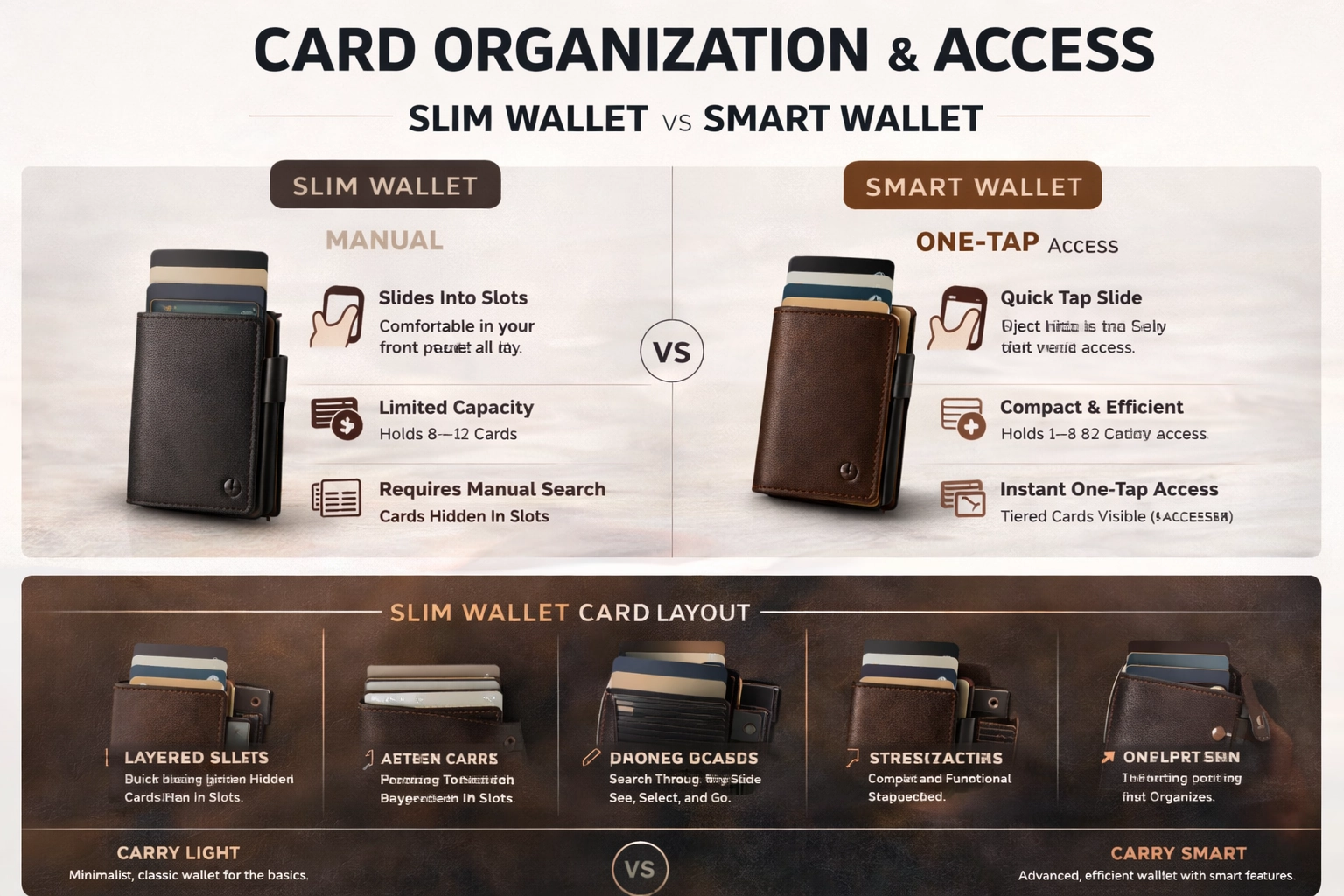
A slim wallet focuses on minimizing bulk.
A smart wallet focuses on improving the carry experience.
Sometimes these overlap. In fact, many smart wallets are also slim wallets. But not every slim wallet is a smart wallet.
That distinction matters because some shoppers think the terms are interchangeable. They are not.
Slim Wallet Priorities
▪️thinner shape
▪️lighter pocket feel
▪️reduced storage
▪️simple carry
Smart Wallet Priorities
▪️better card access
▪️added convenience features
▪️anti-loss or tracking support
▪️more intentional organization
▪️sometimes slim form too
So if your main goal is just to reduce bulk, a slim wallet may already do everything you need. But if you want that slimmer carry plus extra usability, then a smart wallet may be the better fit.
When a Slim Wallet Makes More Sense
A slim wallet is often the better choice if you want something simple, compact, and low-maintenance.
It usually makes sense for:
▪️people who already carry very few cards
▪️users who want a lightweight front-pocket wallet
▪️buyers who prefer a traditional non-tech accessory
▪️shoppers who care more about comfort than extra features
▪️anyone moving away from an overstuffed bifold or trifold
There is also something appealing about a slim wallet’s simplicity. No setup, no app, no extra mechanism to think about. You just move your essentials into a smaller format and carry on.
For a lot of people, that alone is a meaningful upgrade.
If your current wallet is bulky, uncomfortable, or packed with things you never use, switching to a slim wallet can immediately improve daily carry without requiring any change in your routine.
When a Smart Wallet Makes More Sense
A smart wallet tends to make more sense when you want more than just a thinner silhouette.
It is often better for:
▪️people who misplace their wallet often
▪️users who want faster card access
▪️minimalists who also value functionality
▪️travelers who want more intentional organization
▪️buyers interested in tracking, anti-loss support, or RFID blocking
In this sense, a smart wallet is often less about appearance and more about workflow. It can help you carry fewer items, find cards faster, and in some cases reduce the stress of losing your wallet.
This is one reason many shoppers move from broad comparisons like smart wallets vs traditional wallets into more specific ones like slim wallet vs smart wallet. Once you already know you want a more modern wallet, the next step is deciding how much functionality you actually need.
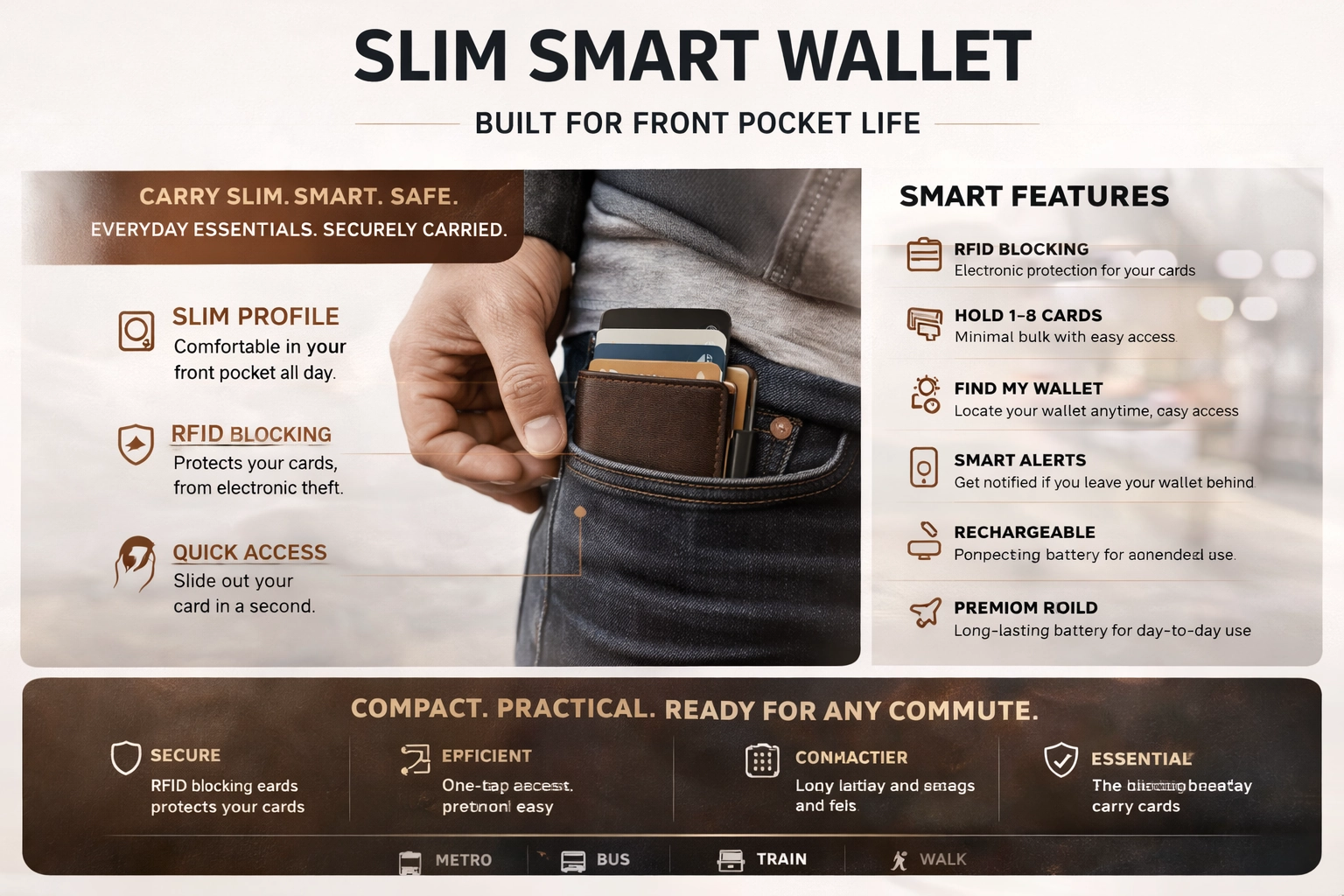
Are All Smart Wallets Slim?
No, but many of them are.
This is part of why the comparison can be confusing. A lot of modern smart wallets are intentionally slim because slim carry is already one of the biggest reasons people upgrade from traditional wallets. However, the fact that a wallet is thin does not automatically make it smart.
A wallet becomes part of the smart wallet category when it adds something beyond compact size, such as:
▪️faster deployment of cards
▪️connected or trackable functionality
▪️anti-loss alerts
▪️modular storage systems
▪️enhanced access and organization
So a slim wallet may overlap with the smart wallet category, but slimness alone is not the defining factor.
Everyday Carry: Which Feels Better in Real Use?
This depends on your habits more than the spec sheet.
A slim wallet often feels better if your daily routine is straightforward. You carry a few cards, maybe a little cash, and you mostly want your wallet to disappear into your pocket without being noticed.
A smart wallet often feels better if your daily routine benefits from speed and structure. Maybe you tap cards often, want cleaner card deployment, worry about losing your wallet, or prefer a more engineered carry solution.
In real use, the difference often comes down to friction.
Choose a slim wallet if you want:
▪️less pocket bulk
▪️a cleaner silhouette
▪️a simple carry upgrade
▪️no learning curve
Choose a smart wallet if you want:
▪️easier card access
▪️more intentional organization
▪️tracking or anti-loss help
▪️a wallet that does more than simply hold cards
This is also where products in the broader minimalist smart wallet space become relevant. If you are browsing options through Coupinify’s ZENLET store page, the practical question is not whether the wallet looks modern. It is whether that style of wallet genuinely improves your everyday carry habits.
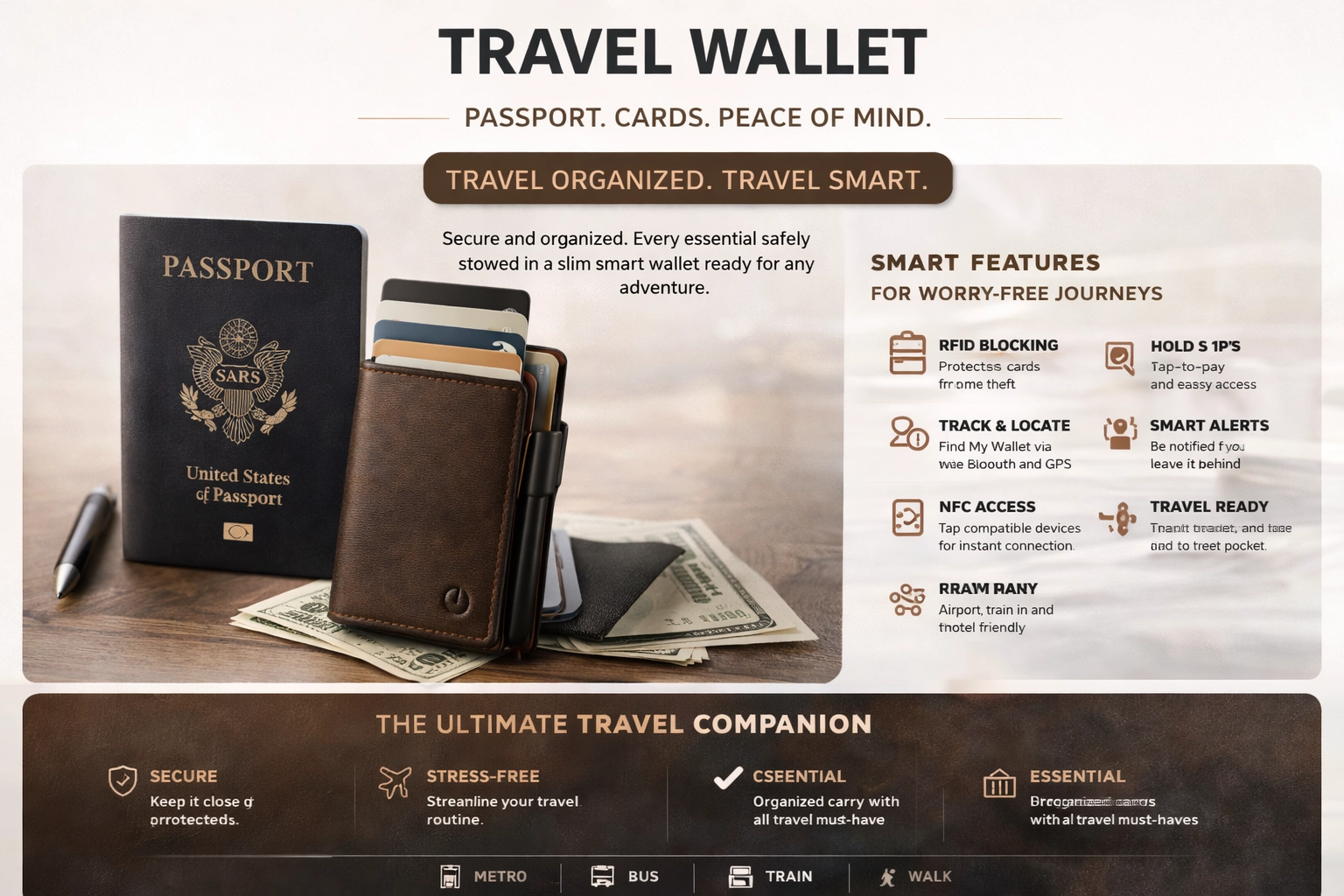
Which One Is Better for Travel?
For travel, a smart wallet often has the edge, but not always.
A slim wallet can work very well for travel if you are carrying only a few cards and want to keep your essentials compact. It can reduce bulk in your front pocket and feel more comfortable during long transit days.
But travel often creates situations where a smart wallet becomes more useful:
▪️quick card access at airports or stations
▪️better organization in unfamiliar environments
▪️anti-loss support
▪️a more controlled setup for important carry items
That does not mean every traveler needs a smart wallet. It means the value of a smart wallet becomes easier to appreciate when movement, speed, and organization matter more.
This is part of the broader modern carry ecosystem connected to electronics and technology, where smart accessories are increasingly designed to reduce small daily frictions rather than just add novelty.
What About RFID Blocking?
RFID blocking is not the main difference between slim wallets and smart wallets, but it often appears in the conversation because many modern buyers want both a slimmer carry and more security.
Some slim wallets have RFID blocking.
Some smart wallets have RFID blocking.
Some have none at all.
So RFID protection is better thought of as a feature layer, not the defining line between the two categories.
If that part of the decision matters to you, the comparison becomes even clearer when you read RFID Wallet vs Smart Wallet: What’s the Difference and Which One Should You Choose?. That article helps separate signal-blocking protection from broader wallet functionality.
Pros and Cons at a Glance
Slim Wallet Pros
▪️lightweight and compact
▪️easy to carry in front pockets
▪️simpler and often more affordable
▪️great for people who already carry less
Slim Wallet Cons
▪️limited features
▪️may still have slower card access depending on design
▪️does not help if you lose it
▪️can feel too minimal for people who want more functionality
Smart Wallet Pros
▪️more feature-rich
▪️may include tracking or anti-loss support
▪️often better for quick card access
▪️combines minimalist carry with added utility
Smart Wallet Cons
▪️can cost more
▪️quality and features vary widely
▪️some models may require setup or accessories
▪️may be more than you need if your goal is only slimness
So Which One Should You Choose?
Choose a slim wallet if your main goal is comfort, reduced bulk, and a cleaner everyday carry setup. It is ideal if you want something compact and simple without paying for features you may never use.
Choose a smart wallet if you want a wallet that actively improves your routine through faster access, better organization, or anti-loss support. It is a better fit when your wallet is not just a place to store cards, but part of a more intentional daily carry system.
A simple way to frame the decision:
▪️Slim wallet = best for minimal bulk
▪️Smart wallet = best for expanded functionality
▪️Slim smart wallet = best for people who want both
For many users, that last option ends up being the sweet spot. It delivers the pocket comfort of a slim wallet while also offering the usability upgrades that make a smart wallet feel meaningfully different.
Final Thoughts
The best choice depends less on trends and more on what problem you are trying to solve.
If your main issue is thickness, choose a slim wallet.
If your main issue is convenience, choose a smart wallet.
If you want a modern carry setup that balances both, look for a smart wallet designed with a slim profile.
That is why this comparison matters. A slim wallet and a smart wallet can look similar from the outside, but the reason you buy them is often very different.
FAQ
Is a slim wallet the same as a smart wallet?
No. A slim wallet is mainly defined by its compact shape, while a smart wallet is defined by broader functionality such as quick access, tracking, anti-loss support, or enhanced organization.
Are smart wallets always slim?
No, but many are. Slimness is common in the category, though it is not the defining feature of a smart wallet.
Which is better for front-pocket carry?
A slim wallet is often excellent for front-pocket carry because that is one of its core design goals. Many smart wallets are also good for front-pocket carry, especially if they are designed with a slim profile.
Is a smart wallet worth it over a slim wallet?
It can be, especially if you value extra convenience, faster card access, or anti-loss functionality. If you only want less bulk, a slim wallet may be enough.